Rechercher dans ce blog

Tuesday, September 29, 2020

On the road with Operation Warp Speed, the U.S. COVID-19 vaccine effort - Science Magazine

with.indah.link

Operation Warp Speed leaders Moncef Slaoui (second from right) and Gen. Gustave Perna (second from left) speak with Cincinnati physicians Carl Fichtenbaum (far right) and O’dell Moreno Owens (far left) during a visit to one of the sites for the efficacy trial of Moderna’s COVID-19 vaccine candidate.

University of Cincinnati Health

Sciences COVID-19 reporting is supported by the Pulitzer Center and the Heising-Simons Foundation.

CINCINNATI—A hospital at the University of Cincinnati (UC) sits on a street named after Albert Sabin, who famously developed a vaccine against polio that has helped rid most of the world of this once widely feared disease. A unit at the hospital now has a similarly ambitious goal as it participates in the U.S. effort to find a vaccine against COVID-19. Last week, on 25 September, the leaders of Operation Warp Speed—the Trump administration program that has committed $10 billion to this vision—flew in from Washington, D.C., for a tour. After learning that the hospital had in about 3 weeks enrolled 130 participants in the multisite phase III efficacy trial of one experimental vaccine, the first question Warp Speed’s scientific director, Moncef Slaoui, asked was, “Do you have a good representation of diverse populations?”

This was one several recent visits to trial sites and vaccine manufacturing plants by Slaoui and his Warp Speed co-leader, Gen. Gustave Perna. The four-star general had on his camouflaged Army uniform and combat boots, but Slaoui, who formerly headed the vaccine division of GlaxoSmithKline (GSK), wore casual slacks, an open-collared shirt, and penny loafers without socks. He aimed to put people at ease on the tour, encouraging them to discuss uncomfortable, even taboo, topics—race, politics, regulations, and risks. Perna made small talk with the clinical staff, but largely kept to himself.

The nationwide efficacy trial, which compares a COVID-19 vaccine made by Moderna with a placebo, struggled at first to enroll Black and Latino participants, in part because the contract research organizations that make up three-fourths of the nearly 100 trial sites had few contacts with those communities. But the UC site and others at academic centers, which are part of the COVID-19 Prevention Trials Network (CoVPN) organized by the U.S. National Institute of Allergy and Infectious Diseases (NIAID), have a long history of working with minority communities to recruit participants for clinical trials. And the clinicians running this UC site explained to Slaoui that about half of their enrolled participants in the Moderna trial are either Black or Latino, a close match to the city’s breakdown. (According to the U.S. Census Bureau, Cincinnati’s 300,000 residents are 50% white, 43% African American/Black, and nearly 4% Hispanic/Latino.)

Moderna tracks—and makes public—the demographics of the enrolled participants week by week. During the week before UC started its enrollment for the 30,000-person trial, participants recruited by the other sites were 67% white and only 9% Black/African American and 17% Latino/Hispanic. Carl Fichtenbaum, a co–principal investigator at the UC site, at a 1 September conference call with fellow CoVPN investigators, NIAID Director Anthony Fauci, and Surgeon General Jerome Adams suggested sites put a cap on the number of white participants they could recruit. “I asked the question, ‘What is more important, getting to 30,000 as fast as we can or ensuring the trial is representative of our country and the pandemic?’” Fichtenbaum recalls. The cap was instituted, and for the week of 21 September, enrollees at all Moderna trial sites were 42% Latino/Hispanic, 30% African American/Black, and 7% white. Cumulatively, as of the day of the Warp Speed leaders visit to UC, 31% of 27,232 participants in the Moderna trial were from “diverse communities.”

The UC team says its recipe for successful minority participation includes relying on trial recruiters from diverse communities, ads that reach out to those groups specifically, and Spanish speakers who are on the clinical team. “We understand the history of Cincinnati—and the history of the problems of our city and the lack of inclusion,” Fichtenbaum says. The hospital, he stresses, not only has long treated the “underserved,” but has “embedded roots.”

Margaret Powers-Fletcher, co–principal investigator at the UC vaccine site, noted that many misunderstandings circle around the Moderna vaccine. On one extreme, Powers-Fletcher was asked whether the vaccine was bankrolled by Bill Gates as an attempt to microchip the population. But, more commonly, people want to know about Moderna’s unusual vaccine technology. The vaccine contains messenger RNA (mRNA), which codes for the surface protein of the virus that causes COVID-19. Explaining this “opens the door” for a deeper conversation, she says. “It gives us the opportunity to not only talk about what mRNA is, but to dispel other myths associated with vaccine.”

Slaoui adds that having diversity in the trials will build “engagement and trust” that translates into wider use of a COVID-19 vaccine that ultimately gets approved. “The vaccine that stays on the shelf, if people are not accepting it, is of no use,” he says.

O’dell Moreno Owens, a Black clinician who heads the Cincinnati-based nonprofit Interact for Health, joined the tour and raised several provocative concerns. One is that Warp Speed now supports efficacy trials of four different COVID-19 vaccines, and the public sometimes has difficulty separating them. A few weeks ago, an international trial of a COVID-19 vaccine candidate made by AstraZeneca and the University of Oxford was put on hold after a serious side effect occurred in a recipient. (Regulators in the United Kingdom and Brazil determined this wasn’t connected to the vaccine and allowed the trials there to resume, but the United States has yet to follow suit.) “The ripple effect in the community was, ‘I told you so, I told you so,’” Owens says. “That’s going to be a big issue.”

“It is a real challenge to be able to communicate about these vaccines and their safety and engaging people to use them. It’s exacerbated by all the lights that are on this,” Slaoui replies. “Unfortunately, the world we live in, this period of time and all the politics around it exacerbates the anxiety that exists.”

Jaasiel Chapman, the trial’s community liaison for the Black community and a native of the city, says there’s no escaping the divisiveness. “People feel like this pandemic has become so politicized and that people want to win elections, rather than save our lives—that’s definitely one thing that we have gotten out in the community,” he says. “They feel the government has never cared about us before, so now they’re just trying to rush through a vaccine to kill us. So that’s been difficult. There are a lot of doubts in the community.”

Much as Slaoui would like to sidestep the politics, they have cast a shadow over him, too. On 25 September, the day of the UC tour, he issued a video that lambasted Senator Elizabeth Warren (D–MA) for suggesting at a Senate hearing that he had conflicts of interest because of his investments in companies making COVID-19 vaccines. “You don’t know me personally and you are publicly accusing me of being greedy, of being corrupt, and of doing this to enrich myself,” seethed Slaoui, who was unusually named to co-lead Warp Speed as a government contractor, not as a federal employee. Sitting at a desk with a Warp Speed logo behind him, Slaoui stressed that he had gone to great lengths to separate his finances from the vaccine effort, only holding on to GSK stock because they are his nest egg for retirement. “I cannot make any benefit from taking this role and my commitment is to helping the American people fight this epidemic. It is mathematically impossible for me to enrich myself,” he said. “I didn’t hesitate to join the role even though I’m a registered Democrat because this pandemic is bigger than any one of us. It’s bigger than me and it’s bigger than you. Please stop distracting me and Operation Warp Speed.”

Warp Speed’s main vaccine concern, as Slaoui repeatedly stressed during the UC visit, was safety. Cincinnati physician James Powell, who heads a project for the National Medical Association—which represents Black physicians and patients—to increase minority awareness about participating in clinical trials shared this worry. He told Slaoui he’s particularly concerned about safety when a vaccine moves from a 30,000-person trial to millions of people in the real world.

Slaoui says that to best balance potential benefits versus risks the vaccines will at first go into people at the highest risk of severe disease. He also endorsed a push by the U.S. Food and Drug Administration (FDA)—which the Trump administration is reportedly challenging—to add a safety measure to vaccine approvals that could slow down the process. Independent boards that monitor the vaccine trials take scheduled looks at the data, and if they see an efficacy signal or dangerous side effects, they can recommend stopping a trial early. An early sign of efficacy, in turn, could lead manufacturers to seek what’s known as an emergency use authorization (EUA).

There is widespread concern that politics might influence the issuance of a vaccine EUA, because critics says President Donald Trump and his allies pushed too aggressively for similar authorizations for two unproven COVID-19 treatments, hydroxychloroquine and convalescent plasma. Although Slaoui and other scientific advisers to the administration have said it’s highly unlikely a vaccine candidate will prove safe and effective in October, before the 3 November presidential election, Trump has repeatedly floated this idea. FDA officials have insisted that politics will not influence their decisions, and they recently proposed a regulation that would not consider an EUA until at least 2 months after the last participant in a trial is fully vaccinated.

Near the end of the visit, Powell asks how many Black investigators are taking part in the Warp Speed trials and how many sites are at historically black colleges and universities (HBCUs).

“The answer is, ‘Not enough,’” Slaoui says. (Two HBCU presidents recently joined COVID-19 vaccine trails and called for their students and faculty to participate, too, but the request also produced some backlash.)

As he says his goodbyes, Slaoui praises the people who participate in the COVID-19 vaccine trials. “It’s a very generous act.” And he laments what he called the “unintended consequence of the communication that’s happening on the political side of things,” which he says was “making people afraid of vaccines.”

“The only way to counter that is to be transparent and explain,” Slaoui says. “And we need everybody’s help. So thank you very much for being here.”

The Link Lonk


September 30, 2020 at 02:45AM
https://ift.tt/2ScEXvL

On the road with Operation Warp Speed, the U.S. COVID-19 vaccine effort - Science Magazine

https://ift.tt/3d5QSDO

New York City election officials to resend ballots after about 100,000 voters get misprints - The Washington Post

with.indah.link

Ryan said the vendor, Phoenix Graphics, will reprint the ballot packages, which will be mailed out to all the potentially affected voters “to make certain that absolutely no disenfranchisement occurs in the borough of Brooklyn.” He said the vendor will bear the cost of the reprint and redistribution.

Phoenix Graphics did not immediately respond to a request from The Post seeking comment.

Ryan did not disclose the number of affected voters. Melissa DeRosa, secretary to New York Gov. Andrew M. Cuomo (D), told reporters during a news conference that the error impacted about 100,000 people in Brooklyn.

“To say we’re troubled by this is the understatement of the year,” DeRosa said Tuesday.

Valerie Vazquez-Diaz, a spokesperson for the board of elections, did not immediately respond to a request for comment from The Post, but told CNN the error affected 99,477 voters.

The new ballots will contain inserts explaining to voters why they’re getting another one, Ryan said. The board will also attempt to reach out to voters to explain the error, and will use social media to inform voters of the problem.

“It is essential that confidence be established in this process and that we make certain that all of the voters who potentially have a problem have a full and fair opportunity to remedy that problem,” Ryan said.

The board of elections called on New Yorkers who received the envelopes with the wrong name to contact them via Twitter, email or to call 1-866-868-3692. The board also posted the message on its Facebook page.

Numerous New Yorkers reported Monday that they had received mixed-up return envelopes, which could invalidate their votes if they tried to mail them in.

Brooklyn resident Kabeer Malhotra requested an absentee ballot for the first time, hoping to avoid the perils of a voting booth during the coronavirus pandemic. But tore open his ballot on Monday to find a return envelope with someone else’s name printed on the front.

In a tweet, New York Mayor Bill de Blasio (D) called the incident “unacceptable.”

He urged voters to check to make sure the oath envelopes included with their ballot has the correct name and address. “If it is incorrect, DO NOT USE IT,” the mayor tweeted.

The mass error comes soon after the election board struggled to tally a flood of absentee ballots in June primaries, leaving some races undecided for weeks. As Republican critics relentlessly assail the security of mail-in voting, the latest mishap — which President Trump highlighted in retweets about the ballot mishap — will only add fuel to that argument, Malhotra worries.

“The rhetoric our president is using and all the fearmongering over mail-in voting makes me worry there’s going to be so much hysteria around errors like this, that people are going to panic,” Malhotra, a 36-year-old who works in the TV and film industry, told The Washington Post. “Some people won’t know what to do.”

Advocates said they were hearing from affected voters in Brooklyn. Many Brooklyn residents also took to Twitter on Monday evening to share their personal stories of mislabeled return envelopes.

“I have heard from dozens of voters individually today, all concentrated in Brooklyn, that they have received return ballot envelopes that are not in their name,” Ali Najmi, a New York elections lawyer, told The Post.

Crystal Hudson, a candidate for New York City Council, said that a neighbor sent her a message that she had received Hudson’s return envelope by mistake. Confused, Hudson then opened all three of her family’s absentee ballots and found that each had the wrong return envelope inside.

“So let’s recap — my neighbor’s wife has my absentee ballot; he has his wife’s ballot; and his is missing,” she tweeted. “These neighbors also shared that they are immigrants & are very excited to vote in their first presidential election as citizens.”

Terry Kinney, an actor and director best known for his role on HBO’s “Oz,” said he opened his absentee ballot Monday after reading about the problems.

“Lo and behold- I got someone else’s ballot,” he tweeted, adding, “Come on, this is a nightmare.”

Carlina Rivera, a city council member, noted that she penned an op-ed in July demanding a review of the city’s elections vendors after issues delivering absentee primary ballots to voters. Instead, she tweeted, the Board of Elections “ignored my warnings w/ disastrous results. There must be a reckoning, starting at the top.”

The mislabeled envelopes weren’t the only printing error spotted on Monday.

NYC Votes, a voter education organization, noted that some residents had gotten ballots labeled, “Official Absentee Military Ballot,” even though they’re not in the military. The organization blamed the issue on a missing slash between the words “absentee” and “military,” and it said those ballots are still valid.

The board of election also tweeted reiterating that such ballots are correct, "even if you are not a military voter."

Malhotra said than risk another mailing mishap, he said he’s going to cast his ballot in person at an early-voting site.

“I’m privileged because I can go in person and make absolutely sure my vote will be counted,” he said. “But I know there are so many essential workers who don’t have that privilege.”

The Link Lonk


September 30, 2020 at 07:17AM
https://ift.tt/2G98kfZ

New York City election officials to resend ballots after about 100,000 voters get misprints - The Washington Post

https://ift.tt/3d5QSDO

Our unannounced Google Chromecast didn’t come with Stadia, but it sure does work - The Verge

with.indah.link

Yesterday, we bought the new Google Chromecast, even though it hasn’t yet been announced. Weirdly, it didn’t come with Google Stadia — of the 12 streaming services prominently pictured on the front of the box, Google’s own cloud gaming service wasn’t one of them. We didn’t find it pre-installed on the device, either.

But we can confirm that Stadia absolutely does work on the new “Google TV” device. When The Verge’s Chris Welch sideloaded the Stadia Android app onto his new Chromecast, it fired up our existing cloud games quite nicely. That suggests Google shouldn’t have much issue bringing official support to the Chromecast, assuming it isn’t already doing so at the Google hardware event tomorrow.

And, assuming the $50 price we paid for the new Chromecast holds, it means you’ll probably soon be able to play Stadia on your TV for $20 less than previously. Originally, Google limited Stadia on TV to the $69.99 Chromecast Ultra. Admittedly, the new Chromecast doesn’t come with an Ethernet adapter in the box like the Ultra, though we can confirm that at least one third-party USB-C adapter does work.

If you’re looking to try this yourself, know that sideloading apps onto Android TV does take a bit of doing; in addition to flicking the typical “Unknown Sources” switch in your settings page, you’ll need to find and trust an APK with your device, and figure out a way to sling the file to your dongle. There are apps that’ll do it wirelessly or via the cloud, or you can go the old-fashioned ADB route. You may also need to tick this flag in the Stadia app:

And even then, we can’t yet say how well the experience will work. With the best-case scenario of a Wi-Fi router right next to the TV, it feels pretty responsive, and it did automatically put our TV into low-latency mode. But we can’t seem to buy games in the app yet — trying to do so causes Stadia to crash — and the app was a big sluggish when loading a larger library of games. We’re also testing with an Xbox controller instead of the official Stadia one.

But as Android Police points out, Google seems to have been rapidly improving the Stadia app’s quiet compatibility with Android TVs, so we’d be surprised if the company doesn’t announce an official Android TV launch for Stadia before long.

The Link Lonk


September 30, 2020 at 02:29AM
https://ift.tt/2S6IsDY

Our unannounced Google Chromecast didn’t come with Stadia, but it sure does work - The Verge

https://ift.tt/3d5QSDO

Catching Up With The Buffs: Mickey Pruitt Gives Back In Work With Chicago Public Schools - University of Colorado Athletics - CUBuffs.com

with.indah.link

BOULDER — After a standout career at Colorado and a five-year NFL stretch that included a Super Bowl ring with the Dallas Cowboys, Mickey Pruitt had multiple opportunities to follow a career path in football.

But in the end, Pruitt followed a different road. He returned home to Chicago to give back to the place where he grew up.

Now, 21 years later, Pruitt is still happy with his decision to work for Chicago Public Schools and help provide the same opportunities for thousands of youngsters that he enjoyed.

"I've been blessed to be here this long," said Pruitt, who has risen through the ranks and is now the Deputy Executive Director for Sports Administration for CPS. "My mom and dad were teachers in Chicago Public Schools and this has always been my home. There are a lot of student-athletes I've seen and talked to that are now grown men and women with successful careers, good families, things like that. It's been very gratifying to be a part of that."

Buffs fans will remember Pruitt as a member of Bill McCartney's first recruiting class in 1983, a group that established the successful foundation of the McCartney era that ultimately led to Colorado joining the nation's list of elite programs. 

A four-year starter at strong safety (1984-87) for the Buffaloes, Pruitt was a three-time All-Big Eight selection (1985-87) and also a member of the 1980-89 All-Decade Big Eight squad. He finished with 332 career tackles (a CU defensive back record that stood for 14 years), was a member of the CU All-Century team selected in 1989 and was a national finalist for the first Jim Thorpe Award in 1986. 

But if there is one moment in his career that Buffs fans remember, it is his sack of Oregon's Chris Miller in 1985 that cemented a 21-17 Buffs victory in Boulder. Pruitt dumped Miller with the Ducks facing a fourth-and-goal in the waning minutes of the game and Colorado holding a four-point lead.

"That (recruiting) class of '83 was his team, his guys," Pruitt said of McCartney's plan. "They were going to be the guys who would help build the University of Colorado."

Indeed, just three players from the 23-member '83 class actually played as true freshmen. But a year later, most of them received their initiation in a difficult 1984 season that saw the Buffs finish 1-10.

"He kind of threw us to the wolves," Pruitt said with a chuckle. "But I think that was his plan. We had to grow up in a hurry. We took our lumps but we learned from it. We learned how to work hard and we learned what it took to win. When 1985 came around, we were like, 'We're ready. Let's go. It's our turn now.'"

Indeed, the heart-stopping win over the Ducks, which improved CU to 2-0, not only doubled Colorado's win total from the previous season, but also set the tone for a 7-4 finish — the Buffs' first winning season in six years — and a Freedom Bowl bid.

It proved to be one of the most important seasons in the entire McCartney era. Coming in Mac's fourth year in Boulder, the Buffaloes needed a turnaround and Pruitt and his teammates delivered, setting the stage for the successful run that followed in the late 1980s and early '90s.

"That class was tight," Pruitt said. "It was a close-knit group and we wanted it. We had a mixture of guys from all over the country. We had guys from Texas, from Florida, from Chicago, from Denver, from California, from Detroit, New York. We had people from everywhere and made it work. It was like a family. We were growing up together and we wanted to leave something for people to remember."

That is exactly what those Buffaloes did. In 1986, they ended a 19-year losing streak to Nebraska with a resounding 20-10 win in Boulder, leading to a second-place finish in the Big Eight and a Bluebonnet Bowl bid. In 1987, Pruitt's final season, CU finished 7-4 for the Buffs' third straight regular season winning record.

"I think we set the foundation," Pruitt said. "Coach McCartney put Nebraska in red letters and none of us will ever forget that."

After his CU career, Pruitt played three seasons with his hometown Chicago Bears, then two more in Dallas, where he picked up a Super Bowl ring in 1992.

After that, he followed the "natural" football road and gravitated toward coaching. He worked two seasons as a graduate assistant in Boulder under Rick Neuheisel, then spent two seasons as a defensive backs coach in Hawaii when Buffs assistant Fred Von Appen took the head coaching job there.

Then, he was ready to take a job with the Bears in player personnel before a chance meeting with a CPS official convinced him to consider a job in public schools. He accepted the offer — and two decades later, he is still there.

"It's one of the things that I wanted to give back to where I came from," Pruitt said. "My parents were teachers, my sister was a teacher in public schools and my brother (Tony, who played basketball at Colorado) and I grew up in Chicago Public Schools. You're working but you're giving back to where you came from. It's been a chance to help a lot of kids have the same opportunities I did."

As Pruitt has climbed the administrative ladder, it has gradually meant less daily contact with students. But he still gets out when he can — and those meetings he has had over the years with those youngsters are still resonating.

Just recently, he received a call from a former student-athlete he helped mentor nearly 20 years ago.

"I don't change my phone number," Pruitt said. "He just called and said, 'Hey, I haven't talked to you in a long time. I wanted to reach out and tell you thank you for everything you did for me. You made a big difference in my life.'"

That young man he helped years ago now has a successful career and family life.

"It's not something you think about growing up, but when you get involved in the process as an adult, you realize how important it is," Pruitt said. "When you get a call like that, it feels good because you know you made an impact."

Like every other sports administrator in the nation today, Pruitt is dealing daily with the obstacles created by the coronavirus pandemic. Chicago Public Schools is the nation's third-largest district, encompassing more than 700 high schools and elementary schools. The schools are currently playing some sports — swimming, tennis, cross country — but others are on hold.

"It's crazy," Pruitt said. "You're dealing with a lot of information that seems to change almost daily and you just try to make the right decisions."

But he also still keeps up with his former teammates such as David Tate, Solomon Wilcots, Rodney Rogers and John Nairn, and they all follow the Buffaloes' fortunes. Last fall, a number of players from those mid-1980s teams made a road trip to Arizona State to watch the Buffs collect a win over the Sun Devils.

"Our connection from that era is great," Pruitt said. "A lot of us still talk all the time and we stay in touch. We've lost some guys from that group, and I think that has made us even closer. It's such an important part of your life … you don't want to lose that connection."

Contact: Neill.Woelk@Colorado.edu

Print Friendly Version
The Link Lonk


September 30, 2020 at 02:38AM
https://ift.tt/3cIuPEk

Catching Up With The Buffs: Mickey Pruitt Gives Back In Work With Chicago Public Schools - University of Colorado Athletics - CUBuffs.com

https://ift.tt/3d5QSDO

Detroit Lions likely to roll with veteran Adrian Peterson as lead running back - ESPN

with.indah.link

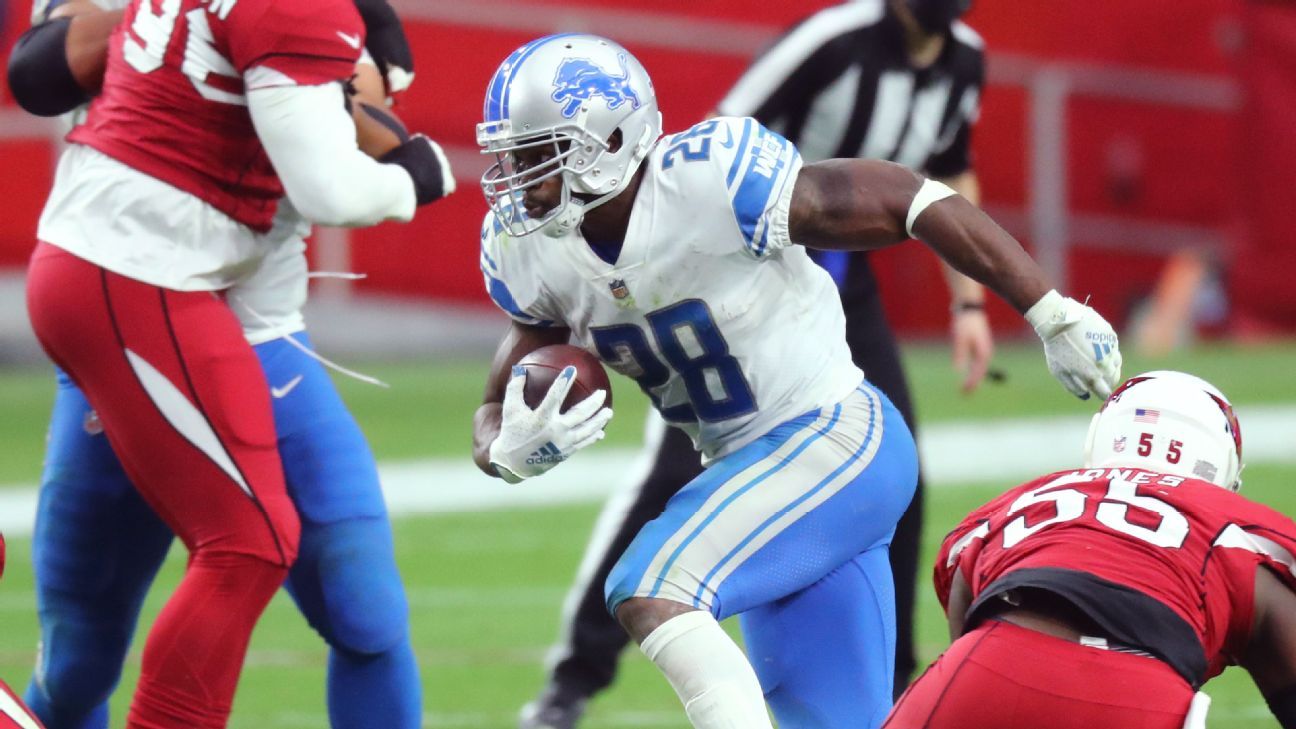
Adrian Peterson had more snaps, rushes and yards than the rest of the Detroit Lions' running backs combined Sunday. And based on what his offensive coordinator, Darrell Bevell, said Tuesday, it looks as though the 35-year-old future Hall of Famer might end up being the lead back for the club for the immediate future as well.

Peterson played 40 snaps in the Lions' 26-23 victory against Arizona on Sunday, getting 22 carries for 75 yards along with one catch for 10 yards. That followed two weeks of a committee approach among Peterson, Kerryon Johnson and D'Andre Swift.

"It's not anything that those guys are or aren't doing," Bevell said. "We're just trying to, again, accentuate their positives and put them in positions to be successful. You saw Swift. His plays were a little bit down. We want to keep those up and get him more involved. The one play he catches, he has a nice catch-and-run, looks fast, looks explosive.

"It's just continuing to manage those guys and putting them in the best situations."

Those situations come with Peterson atop the depth chart. Detroit signed Peterson after he was released by Washington on Sept. 4. He said he had a opportunities to go to a couple of teams, but he chose the Lions because of an opportunity to play again with Bevell, who was his offensive coordinator at the start of his career in Minnesota.

So far, Peterson has averaged 4.9 yards per carry (43 attempts, 209 yards). Johnson has averaged 3.4 yards (18 attempts, 62 yards), while rookie Swift is averaging 2.5 yards (8 attempts, 20 yards).

Bevell did praise Johnson on Sunday, calling him the "player of the game" due to his pass-protection pickup and the nuances that led to Jesse James' touchdown reception. But it appears Johnson, who has been Detroit's lead back when healthy the past two seasons, might not touch the ball as much as he has in the past.

The question now might be whether the Lions have to manage Peterson's workload. He has already played in 167 career games and carried the ball 3,079 times for 14,425 rushing yards. Plus, he's at an age when most running backs are retired or playing a much less significant role.

"I've told you, this guy is a freak of nature now. I don't know where that wall is or where he's going to hit it. The guy is always asking for more," Bevell said. "He is in great shape. He takes care of his body. He does all those little things to set himself up for that success.

"I don't know when it's going to happen, but he wants [the ball], we want him to have it and we'll just keep continuing to go there and spell him with Kerryon, spell him with Swift and kind of go from there."

Running backs coach Kyle Caskey said he and Peterson have an open line of communication about his reps and if he needs rest. Caskey said any management, for now, is "a during-the-week thing," and on game day they are going to play the game.

"He'll tell me," Caskey said. "That's your answer right there. He'll tell me when he's had enough or when he needs a break. He's communicated well with me since he's been here. I don't think it's anything that I personally need to do to watch him.

"He will tell when he's feeling whatever you want to call it. He is that way. He's not scared to tell me anything, so it's really good. It's a really good coach-player relationship we have with everything."

The Link Lonk


September 30, 2020 at 05:30AM
https://ift.tt/36jzThk

Detroit Lions likely to roll with veteran Adrian Peterson as lead running back - ESPN

https://ift.tt/3d5QSDO

Postal Service workers quietly resist DeJoy’s changes with eye on election - The Washington Post

with.indah.link

“I can’t see any postal worker not bending those rules,” one Philadelphia staffer said in an interview.

With the Postal Service expected to play a historic role in this year’s election, some of the agency’s 630,000 workers say they feel a responsibility to counteract cost-cutting changes from their new boss, Postmaster General Louis DeJoy, that they blame for the mail slowdowns. They question whether DeJoy — a top Republican fundraiser and booster of President Trump — is politicizing the institution in service to a president who has actively tried to sow distrust of mail-in voting, insisting without evidence that it will lead to massive fraud.

With a mandate to stabilize the Postal Service’s balance sheet, especially its $160.9 billion worth of debt, DeJoy imposed stricter dispatch schedules on transport trucks that prohibited late and extra trips, forcing workers to leave mail behind. Managers cracked down on overtime, though DeJoy contends they did so of their own accord. He also declined to reinstall hundreds of mail-sorting machines and blue collection boxes removed under his watch. Though he put some of these efforts on hold after public backlash, and four federal judges have since issued temporary injunctions on all operational changes, DeJoy has deeper cuts in store. He told lawmakers last month to expect “dramatic” changes after the November election, including reductions in service and price increases for Americans in rural areas.

DeJoy’s approach marks a fundamental shift, experts say, modeling the agency as more business enterprise than government service. But it also has profound implications for employees in the form of heavier workloads and lost overtime.

In interviews, 15 Postal Service workers and local union leaders in eight states described a deep decline in morale since DeJoy made clear his intent to retool the Postal Service — with little input from the heavily unionized workforce — that have fixed intense public and congressional scrutiny on the agency. They also say they are prepared to defy directives that would limit how they do their jobs.

Most of the workers interviewed for this report spoke on the condition of anonymity because they were acting against agency guidance. Last month, an internal Postal Service memo warned employees not to speak to journalists and to be wary of customers who ask “a series of questions.”

The Postal Service’s dire financial situation, coupled with mounting political pressure, and worries about an election in which nearly 180 million Americans are eligible to vote by mail, has begun to overwhelm its workforce.

“People are burned out,” one New Jersey letter carrier said. “I haven’t been this burned out in a long time, and I’ve been doing this a long time. We’ve never had a summer like this. I tell my customers, ‘Call your congressman, because I’m being told not to deliver your mail.’ ”

‘Every piece, every day’

New postal workers are introduced to the agency’s unofficial motto within their first days on the job: “Every piece, every day.” It’s referenced so frequently that “EPED” is shorthand to work faster, or longer, when mail piles up. Any conscious effort to delay mail is, under federal law, punishable by fine and as much as five years of imprisonment.

Many postal workers see the changes that have slowed mail as violating the spirit, if not the letter, of that law.

They view themselves as couriers of prescription medications, paychecks, bills and more, and also as neighbors to the people on their routes, checking in on elderly residents and delivering life’s necessities. The coronavirus pandemic has only magnified that sense of responsibility, they say.

“You look at the news and you get worried,” said one Philadelphia postal worker. “Are we going to be the end-all, be-all of election integrity and covid response for this country? Having your own personal problems, too, it all adds up. I think it’s really starting to get to people, both newer and seasoned veterans of the job.”

Since his June 15 start, DeJoy has focused on shoring up the Postal Service’s finances. Despite surging package volumes during the pandemic, the agency has been losing ground on first-class and marketing mail — its most profitable products — for years.

“The thing is, right now the size of their hole is so big and continuing to grow, there is no one silver bullet to fix this,” said Kenneth John, president of the Postal Policy Associates consultancy and a former senior analyst at the Government Accountability Office. “They’ve done a lot of the low-hanging fruit already, so you’re left with a set of really difficult choices. You’re left with really big changes.”

What’s more, he added, DeJoy’s efforts can close only a relatively small portion of the agency’s debt. “You’re either left with these difficult choices and big changes, or ultimately, Congress is going to need to pay for it.”

Much of the Postal Service’s financial difficulty is structural: Congress reorganized the agency in 1970 and essentially ordered it to operate as both a public service and business. As such, it is supposed to be self-sustaining without benefit of taxpayer funding. But the passage of the 2006 Postal Accountability and Enhancement Act mandated that it prepay employees’ retirement and health-care benefits, an obligation held by few other government agencies, let alone private companies. Today, retiree costs account for nearly three-fourths, or $119.3 billion, of its debt.

Because the Postal Service lacks revenue streams divorced from mail volumes, nearly any cost-cutting maneuver would almost certainly hurt service, an issue that draws heaps of congressional attention even as lawmakers have put off substantial postal reform. But some of DeJoy’s changes go right to the heart of the agency’s operations. Some flexibility in delivery schedules, such as allowing late or extra delivery trips, ensures that mail arrives on time, experts say, and prevents backlogs.

Postal leaders have long relied on overtime to keep the mail moving, as it is more cost efficient than expanding payroll. That supplemental income is a boon for many workers — comprising nearly 10 percent of all work hours within any given pay period — but an albatross for agency finances. Yet government watchdog groups, including the Postal Service’s Office of Inspector General, have identified overtime as a potential source of cost savings.

“If it means you’re going to hire more workers, there are going to be more families that have a family-sustaining union job, that’s fine with us,” said Mark Dimondstein, president of the American Postal Workers Union (APWU), which represents more than 200,000 current and retired postal employees. “If it means you’re going to cut out overtime and, therefore, the people are not going to get the service that they need and deserve, then it’s horrible.”

The Postal Service needs overtime -- Even in years before the coronavirus pandemic, overtime hours made up a significant portion of all the hours worked at the U.S. Postal Service. In the same early-July pay period going back to 2014, overtime hours made up at least 8 percent of all of USPS's work hours.

The cost-cutting efforts have led to multiday delays in communities all over the country. As of the final week of August — five weeks after DeJoy’s changes took effect — on-time delivery rates for first-class mail had declined from more than 90 percent to roughly 85 percent, according to Postal Service data provided to Congress. For periodicals, they went from 80 percent to 75 percent.

John Barger, a Republican member of the Postal Service’s governing board, told the Senate Homeland Security and Governmental Affairs Committee this month that DeJoy’s changes were starting to “bear fruit” and that the board was pleased with his performance. “The board is tickled pink,” he said.

“Thanks to the great work and dedication of our employees, our service performance continues to improve,” a Postal Service spokesman said in an emailed statement to The Post.

But some workers vividly recalled scenes of mail and packages piling up, days at a time, this summer during the worst stretches of the transition. Postal workers in Michigan and Iowa described seeing entire pallets of boxes go unsorted and sit outdoors in the rain or summer heat. Sometimes the smell of rotting food attracted swarms of flies, they said.

At the Royal Palm Processing and Distribution Center in Opa-locka, Fla., massive stacks of marketing mail sat untouched for 43 days, according to local union officials.

“You know, it’s just disheartening,” said Dana Coletti, president of the American Postal Workers Union Local 230 in Manchester, N.H.

Four federal courts also took issue with DeJoy’s changes. Judges in Washington state, New York, Pennsylvania and the District of Columbia all held that the Postal Service should have sought an advisory opinion from the Postal Regulatory Commission — a process that would have allowed for public comment — before instituting the new cost-cutting measures. The judges blocked the agency from pursuing DeJoy’s plans, and lawyers representing 19 states and a group of voters who brought the suit are in negotiations with the Postal Service over a potential settlement.

‘The stakes definitely feel higher’

The long mail delays made some postal workers think more about the role they’d be playing come election season.

The Pennsylvania primary in early June provided a taste of what was to come, said the Philadelphia worker. Though the pandemic was the biggest worry at the time, “we had a lot of issues. There were people at the plant that weren’t coming in or were sick. We were seeing delays with that. So now we’re looking at this [general election] and going, ‘Oh, jeez, this is not going to be good.’ The stakes definitely feel higher, especially given what this election really means.”

In Michigan, one postal worker considered the removal of public mailboxes, which are subject to periodic checks to ensure they are being used, as disproportionately affecting people of color. When a collection box is removed in a wealthy suburb, residents have the time and resources to push back, said the carrier, who is Black. But when it’s removed in a racially diverse working-class neighborhood, it’s just another government service that’s been clawed back.

“It’s kind of like everything else. It wasn’t built for us,” the worker said of the Postal Service and its relationship with Black people.

DeJoy’s background — he’s donated more than $2 million to the Trump campaign and GOP causes since 2016 — doesn’t help matters, the postal worker said, and makes him feel as though the Republican Party has co-opted the Postal Service.

Taken together, Trump’s repeated attacks on mail-in voting, his connection with DeJoy, and DeJoy’s operational changes look too conspicuous to be coincidental, the carrier said, even if DeJoy has stated publicly that he’d stand up to the president when necessary. Some postal workers say the pushback has to start with them to show that DeJoy’s instructions go against the mail service’s operational and ethical mandates. Plus, they say, they are legally bound to ensure the timely delivery of mail.

In New York, one mechanic expressed dismay that he is surrounded by a “bunch of yes men” who are simply going to follow orders.

“It’s disheartening to hear from my boss that he wants me to do something that could very potentially cripple the system. It’s disheartening to hear that people think we’re going to fail. We handle this kind of volume all the time,” he said of the election. “But if they do these things with delivery times and we get high volume around holiday season and the election, it will fail. No question. It will fail. We should get the ballots out. We really should, but all it would take is one person in a nice shiny suit to say, ‘Leave those ballots, take the other mail.’ And everyone would say, ‘Yes sir.’

“There’s a point where I got angry. I’m not happy at all that I’m being politicized. I’m literally trying to do my job, and they’re telling me that I can’t.”

‘Don’t do anything illegal, unsafe, immoral’

DeJoy on Aug. 18 suspended parts of his cost-cutting program after congressional and public blowback — much of it on social media, where images of mailbox removals were met with suspicion and outrage. But it was too late for most of the 671 mail-sorting machines that had been tapped for dismantling and removal across 49 states, D.C. and Puerto Rico.

The agency said that the massive machines, representing close to 10 percent of its inventory and capable of sorting 21.4 million pieces of paper mail per hour, had been earmarked long before DeJoy and that their decommissioning was simply a reflection of Americans’ diminishing use for letters and growing reliance on package delivery. But many workers saw it as further erosion of a finely calibrated infrastructure, one with real ramifications for customers who rely on the agency for their prescription medications and other crucial deliveries.

“It bothers me, because I like to do my job. Some of us do this for 20 years,” said the New Jersey letter carrier. “You see kids grow up from babies and watch them get married. They see you in Wawa, and they buy you a coffee. They say, ‘This is my mailman, he’s a great guy.’ Now they say, ‘Where’s my mail?’ ”

Postal workers’ responses varied from insubordination to small acts of neighborly heroism. In Florida, one manager told of instructing employees to meticulously document their hours and what happens to mail to uphold accountability standards. There are forms for reporting late or undeliverable mail and to record overtime, though several postal workers say supervisors have downplayed the need to complete them in recent weeks.

“What I try to tell people is this: Yes, if you get an instruction, you should follow the instructions of your supervisor,” the manager said. “But every manual says the same thing: Don’t do anything illegal, unsafe, immoral. Well, my manager knows that if he doesn’t want mail to be reported late, to keep the mail out of my building.”

Last month in New York, machinists were ordered to remove sorting machines and use spare parts to augment another, one of the workers said. The person told supervisors that such a move wouldn’t help; the enlarged sorter would be able to collate mail into more carriers’ routes, but it also would process letters more slowly than two machines doing the job simultaneously. When his supervisor told him to repeat the process for another set of machines, the machinist and colleagues balked and drew out the steps required to implement the change. Eventually, superiors gave up on the order.

By then, House and Senate committees had called emergency hearings to cross-examine DeJoy over his relationship with Trump and his operational changes. “I am not engaged in sabotaging the election,” DeJoy testified before the House Oversight Committee on Aug. 24. Days earlier, he told a Senate panel he planned to vote by mail.

In Toledo, mail is shipped to the Michigan Metroplex outside Detroit for processing. When items arrive too late for the trucks headed to Michigan, a manager not eligible for overtime will hop into a Postal Service van and transport that mail separately, said Martin Ramirez, president of the APWU Local 170. That way, the Toledo offices won’t log overtime hours, even though that worker still puts in extra time.

“This is the dancing between the raindrops,” Ramirez said.

As Toledo’s trucks arrive at distribution centers, clerks scan the wire racks carrying the mail to try to spot medications, checks and bills, said Jennifer Lemke, the clerk craft director at Local 170. Even if the day’s mail gets delayed, Lemke and other clerks will retrieve essential items and send them off with carriers.

When angry customers call the post office or come to the retail window, Lemke said, she apologizes for mail delays, then sends for the local postmaster.

“I will put it off on the people that are causing the damage,” she said.

“My message to [local union members] is: You do what you can to satisfy the customer,” Ramirez said. “Look, we’re going to fight from national on down. I don’t need you losing your job.”

The Link Lonk


September 29, 2020 at 07:00PM
https://ift.tt/3cE50p5

Postal Service workers quietly resist DeJoy’s changes with eye on election - The Washington Post

https://ift.tt/3d5QSDO

Amazon introduces the Amazon One, a way to pay with your palm when entering stores - TechCrunch

with.indah.link

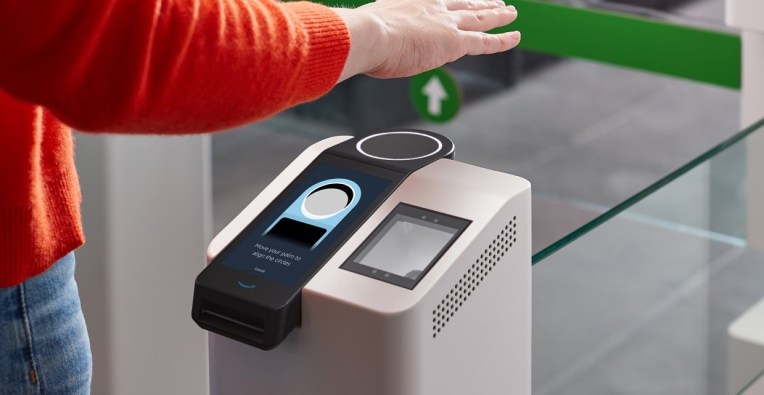
In the middle of a pandemic when customers are often wearing plastic gloves to stores alongside their face masks, Amazon’s physical retail team is introducing a new biometric device that will allow shoppers to pay at Amazon Go stores using their palm. The company on Tuesday introduced its purportedly “contactless” Amazon One, a scanner of sorts where you’ll first insert your credit card, then hover your palm over the device to associate your palm signature with your payment mechanism. Once your card is on file, you’ll be able to enter the store in the future just by holding your palm above the Amazon One device for a second or so.

While you’re not actually supposed to press your palm down on the device itself, it’s a new technology that will require user education — and that could be a problem, at least in the short-term.

Today, consumers are familiar with the idea of pressing down a finger to unlock an iPhone with TouchID, for example, or using a thumbprint to open a secure lock. It’s likely that many will assume you are to also mash your palm down on Amazon One’s flat surface, too.

At any other time, that wouldn’t be much of a concern. But given that the device is being introduced in the U.S. which is still dealing with the COVID-19 health crisis, now may not be the best time to put another potential touchpoint at a store’s entry.

Amazon, of course, stresses that the device is “contactless” which is something customers will appreciate. But unless store staff stands at the entry wiping the device regularly, it will likely be touched a lot as customers get up to speed on how exactly the thing works. Eventually, the Amazon One may achieve the goal of being “contactless.” But in the meantime, the device should be staffed, wiped and demonstrated to everyone who walks in.

Amazon says the new device uses computer vision technology in real-time to create the unique palm signature — a choice the company made because it believes palm recognition is more private that some other means of biometric authentication. That is, you can’t determine someone’s identity just by looking at the image of their palm, Amazon says. That may be true, but given that the palm signature is associated with a payment card, it’s more important that the data is secured rather than how recognizable the palm image is.

Amazon also says the images are encrypted and sent to a secure area in the cloud where customers’ palm signatures are created. There aren’t specific details about this process being provided at this time.

Amazon’s historical use of biometric products has also been controversial, however, having sold biometric facial recognition services to law enforcement in the U.S. Its facial recognition technology is also the subject of a data privacy lawsuit. Its Ring camera company was discovered to be working in partnership with police, raising civil rights complaints. And recently, it launched indoor drones for home security, in a new potential threat to homeowner privacy. In terms of user data privacy, Amazon hasn’t been careful either — for example, by continuing to store Alexa voice data even when users deleted audio files. 

There is room, then, to question Amazon’s plans to create a database of customer database of biometric data.

Amazon says its new device doesn’t require you to have Amazon.com account to enter the store — just a palm and phone number — but customers can associate their account to see their usage history on the Amazon website. They can also add a second palm print, if they choose.

The Amazon One is being trialed at two Seattle-area stores, including the original Amazon Go store at 7th & Blanchard and the store in South Lake Union at 300 Boren Ave. North. It won’t replace the other ways to enter the stores, however. Customers can still enter using the Amazon Go app, Amazon app, or with associate assistance if they want to pay in cash.

The Amazon One doesn’t have to be used only for entry to retail stores, the company notes. It envisions the device being used by third-parties including stadiums and office buildings, as well as other non-Amazon retailers.

Amazon says discussions are underway with some interested parties, but it has nothing to announce at this time. It’s unclear to what extent a third-party retailer would trust Amazon to host its customer transaction data, however, given Amazon’s history in using third-party data in an anti-competitive fashion.

The Link Lonk


September 29, 2020 at 09:59PM
https://ift.tt/3jdfK09

Amazon introduces the Amazon One, a way to pay with your palm when entering stores - TechCrunch

https://ift.tt/3d5QSDO

Featured Post

Montevallo in talks with potential tenants for Victory building - Shelby County Reporter - Shelby County Reporter

with.indah.link By EMILY SPARACINO / Staff Writer MONTEVALLO – Mayor Rusty Nix is set to enter into negotiations with potential restaura...

Popular Posts