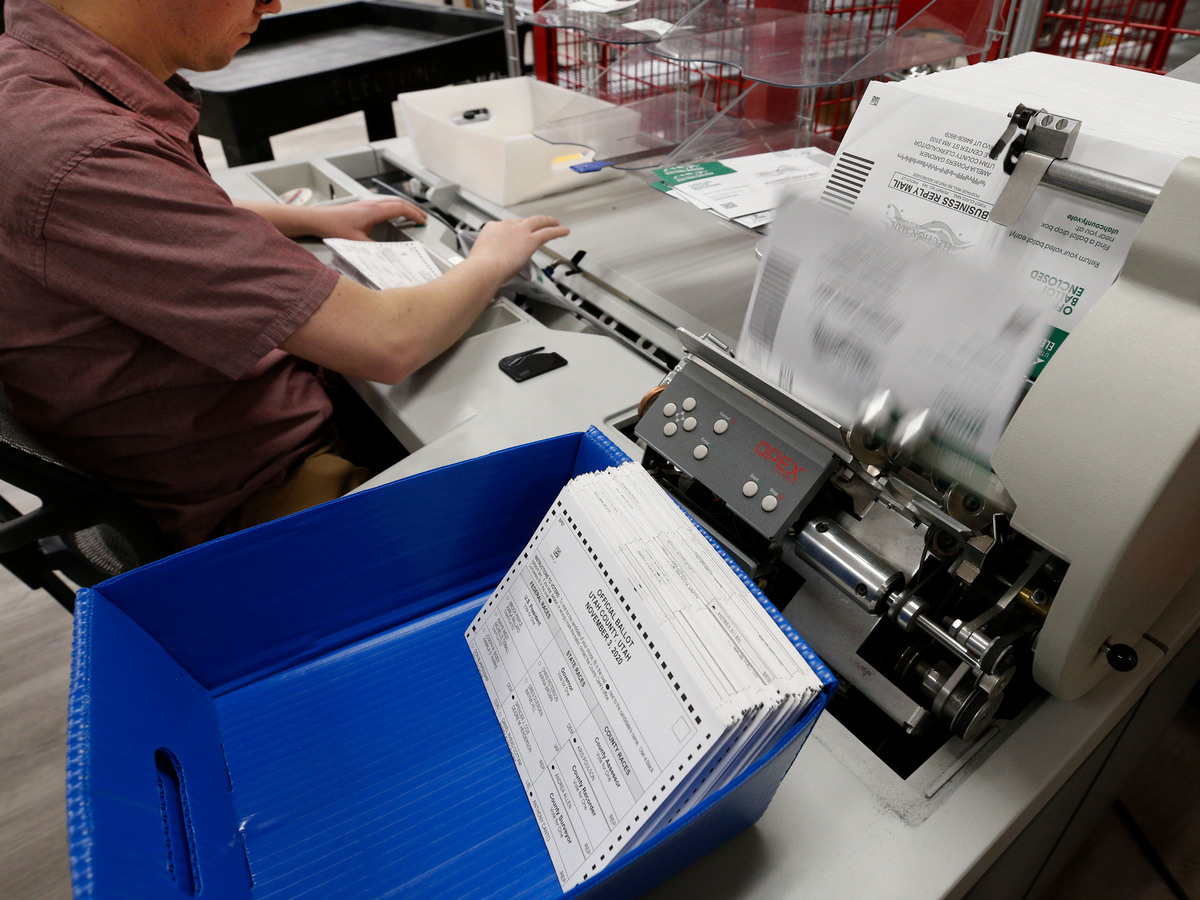
An election worker opens envelopes and removes ballots so they can be counted at the election office on Octo. 26, 2020 in Provo, Utah. George Frey/Getty Imageshide caption
toggle caption
George Frey/Getty Images
An election worker opens envelopes and removes ballots so they can be counted at the election office on Octo. 26, 2020 in Provo, Utah.
George Frey/Getty Images
In a year when millions of people are voting by mail, overseas troops were among the first to receive their ballots. San Diego County is one of 11 counties in the United States that have more than 10,000 military and overseas absentee voters, according to a 2018 report by the U.S. Election Assistance Commission.
County Registrar of Voters Michael Vu said there has never been a hint of widespread fraud, though not every ballot comes back in time to be counted. Federal law requires military and overseas voters to have some method of returning votes electronically. In California, these voters can fax the ballots to the county.
"In many cases, we don't know what the status of that military and overseas voters is," Vu said. "Could they be on a ship, which doesn't have good transmission when it comes down to fax?"
Still, most overseas troops use the mail, which is why the law requires their ballots to go out early.
"The reason why is the transit time of getting them their ballot," Vu said. "And of course the other is giving them sufficient time to vote it and get it back through whatever postal system of where they are at."
Even with the extra measures, over the last two presidential elections, military personnel actually voted at a lower percentage than other absentee voters, both in San Diego County and nationally. Roughly 26% of eligible military voters cast a ballot in 2018, while the number for the general population was 52%, according to the Federal Voting Assistance Program.
This election, polls show military voters may be more in play than in previous years. A Military Times poll of active duty troops in August showed former Vice President Joe Biden holding a lead, with President Trump's approval rating well below what it had been at the start of his term.
San Diego County Registrar of Voters Michael Vu tours the warehouse where the county keeps its polling place supplies. Mike Damron/KPBShide caption
toggle caption
Mike Damron/KPBS
"Military families are not unlike the rest of the electorate, and we're seeing Joe Biden do better with older folks and with white folks and with men across the board," said Eli Yokley, a senior reporter at Morning Consult, which also has been tracking military and veterans households. Yokley said the group has typically been a reliable part of the Republican base, and in some ways it still is.
The polling group Morning Consult surveyed veterans and active duty households in early September, after an article in The Atlantic reported the president had called people who served "suckers and losers." Trump has denied the report and the poll found Trump's support holding steady. He still led among a sample that included both military and veteran households.
"I think we've seen with white voters and with men, who are sort of the Trump base, not a lot has moved their views, across the board, over the last four years," Yokley said.
Back from Walter Reed Medical Center after being diagnosed with COVID-19 in October, Trump tweeted a video message to military voters, one of the groups he is still actively courting.
"We got everybody pay increases. Three of them. There's never seen anything like what I've done for the military," Trump said in the message recorded on the White House lawn. For most candidates, it's hard to target military voters directly.
Department of Defense regulations make it difficult to hold events on base. Democrat Doug Applegate, a retired Marine, ran for Congress in 2016 and 2018. The district included the sprawling Camp Pendleton in Southern California, where more than 36,000 people live on base.
"I wouldn't go on base," Applegate said. "I was asked that on occasion. And I thought that regulation was well founded. Because I don't think the military needs to be sucked into politics."
Applegate, who didn't win a seat in Congress, said military voters tend to be conservative, but not always. National security is important to them, and they tend to size-up which candidate will do the best job of being their commander in chief.
And even though they may be insulated from the job market, they still vote with their pocketbooks, Applegate said.
"I think they look at the economy like everybody else," he said. "Because active duty military still buy homes. They still live in the community where they're stationed at."
At his rally in Green Bay, Wis., President Trump maintained that Black voters are not supporting Joseph R. Biden Jr., the Democratic presidential nominee, because of his support of the 1994 crime bill.CreditCredit...Doug Mills/The New York Times
President Trump and former Vice President Joseph R. Biden Jr. headed into the final weekend of the presidential campaign barnstorming a series of Midwestern states that will help decide who wins the presidency — and that are all grappling with coronavirus outbreaks so severe that the federal government considers them in the “red zone.”
Their differing approaches to the virus came into more vivid relief with each campaign stop.
Even as the country reported a record number of coronavirus cases in the past week, Mr. Trump continued to insist on Friday that the disease was not serious.
At a rally in Michigan, a state that recorded a 91 percent increase in new cases from the average two weeks earlier, he made the extraordinary accusation that American doctors were profiteering from coronavirus deaths, claiming they were paid more if they report that patients have died of the virus. He also mocked Laura Ingraham, the Fox News host who attended the rally, for wearing a mask, saying she was being “very politically correct.”
Mr. Biden, in Iowa, took the opposite approach, pointing out the record number of new cases in the state and noting that the Iowa State Fair had been canceled this year for the first time since World War II. “And Donald Trump has given up,” Mr. Biden said.
At a stop in Minnesota, Mr. Biden brought up Mr. Trump’s accusation about doctors profiting from virus deaths as he assailed the president over his handling of the pandemic.
“Doctors and nurses go to work every day to save lives,” Mr. Biden said “They do their jobs. Donald Trump should stop attacking them and do his job.”
The candidates were planning to stump in four states: both had planned stops in Wisconsin and Minnesota, and Mr. Biden appeared in Iowa while Mr. Trump held a rally in Michigan. All four states were listed as being in the “red zone” for virus cases in a report issued this week by the White House coronavirus task force, which cited their high per capita rate of cases.
ON THE TRAIL
Video
transcript
0:00/1:22
-0:00
transcript
In Iowa, Biden Criticizes Trump’s Treatment of Farmers
Joseph R. Biden Jr. slammed President Trump on Friday for trade policies that have “cost farmers and manufacturing so badly.”
They’re Iowa values, they’re American values. You value honor, decency, respect and dignity. You know they all matter. They matter a lot. That’s who we are. And as we saw in the debate, we’re a farmer’s daughter knows a break-even point for price of corn, crops. You think that’d be fairly basic. That’s like my not knowing where the Delaware River was back home. Let’s not forget how Donald Trump’s weak and chaotic China trade policy has cost farmers and manufacturing. so badly. Agricultural exports to China during the Trump years have been 40% lower than during the Obama-Biden second term. On his watch. He says because of his bailouts, our farmers do better now than when they actually had a farm. I got to read that again. Our farmers actually doing better now than when they actually had a farm. Where’s this guy from? In 2008 and 2012, you placed your trust in Barack Obama and me, and we worked for you, for the entire country. Well, I’ll do it again in 2020.
Joseph R. Biden Jr. slammed President Trump on Friday for trade policies that have “cost farmers and manufacturing so badly.”CreditCredit...Erin Schaff/The New York Times
Joseph R. Biden Jr. hurled a barrage of attacks at President Trump during a drive-in rally in Iowa on Friday, slamming him on his mismanagement of the coronavirus response and denouncing his trade policies that have “cost farmers and manufacturing so badly,” in a sign of how competitive the state has become with just four days left in the campaign.
Speaking at the state fairgrounds in Des Moines, Mr. Biden made a series of direct appeals to Iowans, noting the surge of coronavirus cases in the state and speaking more than usual about trade policies in terms of how they have affected farmers, who make up a considerable part of the state’s economy.
And in an especially blunt entreaty, he reminded voters that they had helped elect him and former President Obama, who won the state twice.
“In 2008 and 2012, you placed your trust in Barack Obama and me, and we worked for you, for the entire country,” he said. “I’ll do it again in 2020.”
Mr. Biden also praised the Democratic candidate for United States Senate, Theresa Greenfield, who is in a very tight race against her Republican opponent, Senator Joni Ernst. In a particularly biting barb in a state blanketed with farms, he knocked Ms. Ernst for not knowing the correct break-even price of soybeans, a key crop in Iowa, at a recent Senate debate.
“You’d think that’d be fairly basic,” he said. “That’s like my not knowing where the Delaware River was back home.”
While Iowa could be crucial to a Biden victory this year, the state was not kind to him during the first-in-the-nation caucuses nine months ago, when he came in fourth.
But Mr. Biden now finds himself in a much stronger position, in part because of the bungled coronavirus response by Mr. Trump and Iowa’s mask-resistant Republican governor, Kim Reynolds. The state is seeing a sharp increase in coronavirus rates, with outbreaks racing through several meatpacking plants. The virus has killed more than 1,700 people there.
Iowa Democrats think Mr. Biden has a decent chance to win back a state where Barack Obama won by nearly 6 percentage points in 2012 but Mr. Trump won by more than nine points in 2016.
“People here are cautiously optimistic and see this as a real shot to win,” said Zach Wahls, a prominent state senator in eastern Iowa who supported Ms. Warren in the caucuses.
“On caucus night, I don’t think I would have ever said that I’d be excited to vote for Joe Biden,” he said. “And I was thrilled to vote for Joe Biden.”
Complicating matters, however, may be the coronavirus, which continues to rampage across the state. On Thursday, NPR reported that voters would not be able to cast their ballots at polling places in cities including Waterloo, Fort Dodge and Council Bluffs because of closures resulting from the virus.
Mr. Biden is set to hold two more rallies on Friday, in Minnesota and Wisconsin.
A group registering people to vote in Kenosha, Wis., in September following the shooting of Jacob Blake by police. Systemic racism and police reform have emerged as dominant themes in a number of local elections.Credit...Chang W. Lee/The New York Times
Last year, the office of Bo Duhé, the district attorney for Louisiana’s 16th Judicial Circuit, made an unusual motion to have Lori Landry, the first Black female judge in the district, removed from more than 300 cases. Mr. Duhé’s office argued that Ms. Landry was biased against prosecutors, in part because she accused them of racial bias in their treatment of defendants.
Now Ms. Landry, who left the bench in July, is challenging Mr. Duhé in his re-election bid.
While the coronavirus and battered economy have overtaken issues of race as the focal points in presidential and congressional campaigns, systemic racism and police reform have emerged as dominant themes in a number of local elections. From California to Louisiana to New York, many voters said they saw the races for sheriffs, prosecutors and council representatives as having more consequence to their lives.
Ms. Landry has centered her campaign on the racial disparities she complained about from the bench. “I was never afraid for the safety of my brothers like I’m afraid for the safety of my 21- and 28-year-old nephews,” Ms. Landry, 57, said. “It has shaped me as a person. But it also has pushed me in a race that I might not otherwise be in.”
Mr. Duhé, who is white, did not respond to calls and emails seeking comment. But in interviews with other news outlets he has stressed the need to protect victims and provide alternatives to incarceration for defendants.
Hoping to harness the energy at demonstrations amid a national conversation about race, racial-justice organizations pushed massive voter registration drives over the summer. The Movement for Black Lives, a coalition of activist groups, hosted a series of virtual town halls and conventions focused on election issues. And local chapters of Black Lives Matter hosted Instagram live chats with candidates to weigh their positions on issues of race and policing.
But there is a racial divide over the importance of race in this election season.
In a Pew Research Center survey that interviewed 7,485 registered voters in July and August, at the height of the unrest and the nation’s reckoning over systemic racism, 85 percent of Black and 66 percent of Hispanic respondents viewed “race and ethnic inequality” as very important to their vote, compared with 43 percent of white voters.
“The stakes, I will say, have never been higher,” said Martin Luther King III, the son of the famed civil rights leader. “I think the vast majority of Black Americans — and really Americans — believe that we’ve got to address the issue of race, systematic racism.”
Will Wright contributed reporting.
Gov. Brian P. Kemp of Georgia is quarantining after he was exposed to someone with the coronavirus. Credit...Alyssa Pointer/Atlanta Journal-Constitution, via Associated Press
Gov. Brian Kemp of Georgia, whose early efforts to lift pandemic restrictions in his state were deemed too hasty even for President Trump, has quarantined himself after coming into contact with someone who tested positive for the coronavirus, his office said.
Mr. Kemp was exposed “within the last 48 hours to an individual who recently tested positive” and will be quarantining, the governor’s office said in a statement Friday. The governor tested negative for the virus, the statement said.
It is not clear if Mr. Ferguson was the infected individual the governor’s statement was referring to, but he did interact with Mr. Kemp more than once this week, according to local press accounts.
Pictures of the pro-Trump event, during which Mr. Kemp touted his opposition to the Affordable Care Act, show dozens of attendees standing close together at an outdoor venue, with many not wearing masks.
Mr. Trump has mocked his opponent for employing social-distance circles at his speeches, including the one at the spa town in Georgia, which was Franklin Delano Roosevelt’s favorite vacation and rehabilitation site.
Mr. Ferguson said he had cold-like symptoms on Thursday night, but he downplayed the danger to people he has encountered since contracting the illness. The LaGrange Daily News reported that Mr. Ferguson and Mr. Kemp had appeared together again Thursday night at an indoor campaign event for a local candidate in Hogansville.
“While the vast majority of my recent schedule has been virtual, we are beginning the process of reaching out to anyone I have seen in recent days,” said Mr. Ferguson, adding that he was well enough to work from home.
A sign to encourage voting hangs in a fence at Lafayette Square in Washington.Credit...Stefani Reynolds for The New York Times
The 2020 Cooperative Election Study released preliminary data on Friday, offering a detailed picture of the U.S. electorate with particular insights into the voting habits of small subgroups.
The study, which reached over 70,000 online respondents from late September through this week, will be matched up after the election with official voter data to determine precisely how groups across the country turned out. Set for release in February 2021, the resulting data will be similar to an exit poll, while in some ways offering more precise and detailed information.
It will also be publicly accessible, as the study always is. This year, for the first time, the results are easily accessible via a shinyapps.io portal, allowing everyday users to view and analyze the data.
“People can get online and just peruse it, see what they see in the tables and charts,” Stephen Ansolabehere, a professor of government at Harvard University who helps lead the study, said in an interview.
The preliminary release on Friday — using data assembled by YouGov, which utilizes a non-probability sampling method to reach a huge swath of Americans online — offers an opportunity to drill into the voting preferences of demographic groups on the eve of the election. Because of its enormous sample size, the Cooperative Election Study can be particularly useful in analyzing subgroups that are too small for most pre-election polls to accurately capture.
For instance, the study’s results show that Asian-Americans are set to vote for Joseph R. Biden Jr. by more than 2-to-1, nearly matching Hillary Clinton’s success with this group four years ago.
The survey also found that, in the midst of the coronavirus pandemic and the related economic downturn, Mr. Biden is overwhelmingly supported by voters who were currently unemployed, those who said they knew someone who had caught the virus and those who had been laid off within the past year.
This year, for the first time, the survey also tabulated how respondents voted for president four years ago. It found Mr. Biden holding onto the support of 95 percent of voters who had cast ballots for Mrs. Clinton in 2016, while Mr. Trump was retaining 90 percent of his supporters from four years ago. Among voters who had not turned out in 2016, Mr. Biden led by a 2-to-1 margin, although many in this group didn’t express a vote preference.
The study, which was previously known as the Cooperative Congressional Election Study, has been conducted since 2006 by a consortium of university researchers spearheaded by Harvard.
Supporters of former Vice President Joseph R. Biden Jr. picking up lawn signs in Fort Myers, Fla., last week.Credit...Eve Edelheit for The New York Times
For Joseph R. Biden Jr. to capture Florida, he needs a lot of voters who cast their ballots for President Trump four years ago and eventually came to regret it.
That includes voters like Gerry Miller, a retiree who wrote in his own name for president in 2016 to protest the choice between Mr. Trump and Hillary Clinton and is appalled by how Mr. Trump has handled the coronavirus pandemic.
“I probably have friends of mine that wouldn’t speak to me again,” said Mr. Miller, 71, who lives with his wife in a beachfront condo in Southwest Florida, a Republican bastion that has helped elect Republican candidates in election after election and was pivotal for Mr. Trump in 2016.
Older voters make up a crucial electoral demographic in Florida, where more than a quarter of the population is over the age of 60. National and state polls show that Mr. Biden has made inroads with them, including with voters age 65 and older, who typically vote Republican.
Especially notable are older Floridians who skipped the last presidential election but have cast ballots this year. New voters tend to be younger. But this year, more Florida voters age 65 and older who did not vote in 2016 have voted than new voters age 30 and younger.
“There are a lot of seniors in Florida who stayed home in 2016,” said Tom Bonier, the chief executive of TargetSmart, a Democratic data firm. “But we’re seeing them come out now.”
But there are signs that Mr. Trump’s base is turning out in a big way again: As of Friday, the turnout in Collier and Lee counties, both of which the president won in 2016, was among the highest in the state, at 70 percent and 61 percent, respectively. (The highest was 75 percent, in Sumter, which includes most of The Villages, a vast retirement community in Central Florida.)
In Lee County, which Mr. Trump won by 20 points, Jim Rosinus, 68, the vice chairman of the local Democratic Party, said he stopped counting the number of volunteers this year after it reached 1,000. In 2016, that number was about 200, he said. The party’s crammed office space features a framed portrait of former President Barack Obama, a cutout of Justice Ruth Bader Ginsburg and $5 sunglasses — “Joe aviators.”
Annie Brown contributed reporting.
ON THE TRAIL
Senator Kamala Harris plans to spend much of the day in Texas, with stops in McAllen and Houston tonight.Credit...Nitashia Johnson for The New York Times
FORT WORTH — Senator Kamala Harris urged Texas Democrats on Friday to keep fighting hard, as early voting numbers shattered records in this traditionally ruby red state.
More than 9 million people have already voted in Texas, more than cast ballots in the state in the entire 2016 election. About a quarter of those voters did not cast ballots in 2016, according to TargetSmart, a Democratic data firm,
“You all have been doing your thing,” Ms. Harris, told a socially distanced audience gathered on a sunny afternoon in Fort Worth. “Now, we know this is no time to let up on the pedal, though.”
That Ms. Harris plans to spend much of the day in Texas, with stops in McAllen and Houston tonight, underscores the political changes sweeping this fast-growing state. Polling shows a near dead heat, giving only a slight edge to President Trump.
Much of the increased Democratic support in Texas has come from demographic changes in the suburbs of Dallas and Houston, where voters have been turned off by the president’s divisive rhetoric and disapprove of how he’s handled the coronavirus pandemic.
The Biden campaign has not put significant time or money into Texas, despite the pleas of local Democrats. Strategists in the state see a path to winning that largely mirrors Ms. Harris’s itinerary: Record turnout in urban areas, capturing suburban swing voters and boosting numbers in traditionally lower turnout border areas.
Ms. Harris warned of Republican efforts to suppress voting rights, pointing to lawsuits and complicated rules for mail voting.
In Texas, a state that does not permit no-excuse absentee voting, Gov. Greg Abbott extended early voting by an additional six days over the objections of his fellow Republicans. But he’s also aggressively sought to limit the drop-off locations for absentee ballots.
“They know our power,” she told the largely Black audience. “They know that when we vote, we win.”
Election clerks set up a drive-through voting booth at NRG Park in Houston Friday morning. Early-voting turnout in Harris County, which includes Houston, has been enormous.Credit...Tamir Kalifa for The New York Times
Texas, a 2020 jump-ball state once considered a layup for Republicans, is shattering turnout records, with the number of early in-person and mail- ballots now exceeding the total number of votes cast statewide in the 2016 election.
Early-voting turnout has been enormous across the country, spurred by the coronavirus pandemic and one of the most bitterly contested presidential races in history, accelerating a years-in-the-making shift away from Election Day-only voting.
In 11 states, voters have already submitted 80 percent of the ballots cast in those states in 2016, and five of them — Florida, Georgia, North Carolina and Nevada, along with Texas — are battlegrounds.
Texas, the nation’s second most-populous state, was the second to pass its 2016 threshold. (The first was Hawaii.) The Texas secretary of state’s office reported Friday morning — the last day for early voting in the state — that 9,009,850 people had already voted by mail, dropped ballots in boxes or showed up at polling sites. Four years ago, a record-breaking 8,969,226 Texans voted in the election.
The Texas increase has been fueled by huge turnout in urban, Democratic areas, like Harris County, home to Houston, but rural counties that have traditionally voted Republican have also seen significant jumps in voting.
Polls show a near dead-heat in the state, with a slight edge for President Trump.
Though Joseph R. Biden Jr.’s running mate, Senator Kamala Harris, is making a late swing through the state today, with visits to Houston, McAllen and Fort Worth, the Biden campaign has not put significant time or money into the state, arguing that it is a bad investment: Texas has multiple expensive media markets and is not an essential stop on Mr. Biden’s path to 270 electoral votes.
Early-voting patterns, especially in big cities like San Antonio and Austin, suggest that the underlying dynamics of the race are less like 2016, when Mr. Trump won by 9 percentage points, than the 2018 midterms, when Senator Ted Cruz, a Republican, narrowly beat Representative Beto O’Rourke, a Democrat.
The surge in turnout comes despite the fact that Texas’s governor, Greg Abbott, a Trump ally, has limited the number of drop boxes to one per county, an order that greatly advantages low-population counties where Republicans predominate.
The drop-box limit has been offset by big new investments in election infrastructure in Harris County and elsewhere. Harris County officials opened 10 drive-through voting sites across the county, fighting off an effort by the state Republican Party to shut them down. A separate action by the governor, extending the statewide early voting period by six days, has also contributed to the increases.
Lil Wayne cited the president’s Platinum Plan, a vague two-page document rolled out in September that promised to “increase access to capital in Black communities by almost $500 billion” over the next four years.Credit...Jeff Hanisch/USA Today Sports, via Reuters
President Trump’s photo op on Thursday night with Lil Wayne, the multiplatinum rapper, immediately went viral on social media. The backlash came swiftly too, making Lil Wayne the latest in a line of rappers to align themselves, however briefly, with the president’s re-election campaign, only to face criticism from fans and fellow artists.
“Just had a great meeting with @realdonaldtrump,” Lil Wayne posted to his nearly 35 million followers on Twitter after the two posed together in Florida, earning a retweet from the president. “He listened to what we had to say today and assured he will and can get it done.”
Just had a great meeting with @realdonaldtrump@potus besides what he’s done so far with criminal reform, the platinum plan is going to give the community real ownership. He listened to what we had to say today and assured he will and can get it done. 🤙🏾 pic.twitter.com/Q9c5k1yMWf
Lil Wayne, like Ice Cube before him, had cited the president’s Platinum Plan, a vague two-page document rolled out in September that promised to “increase access to capital in Black communities by almost $500 billion” over the next four years.
Charlamagne tha God, a host of the radio show The Breakfast Club, responded in a segment on Friday morning, calling Lil Wayne’s apparent endorsement a distraction. While he noted that Black voters are not monolithic, Charlamagne added, “Trust me when I tell you, Black people are not on the Trump administration’s agenda, nor will we ever be. All of our civil liberties are at risk.”
Earlier this month, the New York rapper 50 Cent also seemed to endorse President Trump in a post on Instagram, claiming Joseph R. Biden Jr. would raise taxes. “I don’t care Trump doesn’t like black people,” 50 Cent wrote. “62% are you out of ya [expletive] mind.” (Instagram marked the post as “missing context” and in need of a fact-check.)
But the rapper soon walked back his support for Mr. Trump, and on Thursday, he reacted negatively to Lil Wayne’s political post.
“oh no,” 50 Cent wrote on Thursday evening. “I WOULD HAVE NEVER TOOK THIS PICTURE.”
Ice Cube, a founding member of N.W.A., who released a song called “Arrest the President” as recently as 2018, faced similar scrutiny after it was announced this month that he had consulted with the Trump administration on the Platinum Plan. He said later that he hoped to work with both sides, and was not endorsing Mr. Trump, adding, “I don’t trust none of them.”
Throughout the campaign, Mr. Trump has called himself the best president for Black Americans since Abraham Lincoln, despite having stoked racial divisions before and since being elected president and repeatedly refusing to denounce white supremacists. His campaign has said that it hoped to slightly improve on its performance with Black voters in 2016, when he earned the support of about 8 percent of Black voters.
While rappers like Cardi B, Offset and Snoop Dogg have expressed support for Mr. Biden, others like Waka Flocka Flame and Lil Pump, who is of Mexican and Cuban descent, have signaled an openness to supporting the president.
President Trump will cap off the 2020 presidential campaign with a two-day, seven-state, 10-rally mad dash that embodies his total saturation approach to politics and his faith in overcoming obstacles through perpetual motion, force of will and a torrent of talk.
As a warm-up, Mr. Trump, who was briefly hospitalized with the coronavirus just a few weeks ago, will make a three-rally trip to the battleground state of Pennsylvania on Saturday, with stops in Reading, Butler and Montoursville, where he is expected to appear with other Republican candidates.
The real frequent flying happens Sunday and Monday, a pair of five-rally days intended to emulate the breakneck pace of his 2016 homestretch, a golden and nostalgic period for Mr. Trump, who believes he outworked Hillary Clinton to win the presidency.
Mr. Trump’s Sunday starts in Macomb County, Mich., outside Detroit, long viewed as a national bellwether, with a morning rally at the Total Sports Park Complex. From there he flies to Dubuque, Iowa, for an afternoon event, then east to Hickory, N.C., for an evening rally.
The day concludes with stops in Rome, Ga., where he is expected to campaign with the embattled Republican Senator David Perdue, and an 11:30 p.m. rally in Opa-locka, Fla., near Miami, an hour’s drive south of his residence at the Mar-a-Lago Club.
On Monday, Mr. Trump works his way back north, flying to Fayetteville, N.C., for a morning speech (a makeup of a rally he canceled on Thursday), then on to Scranton, Pa., Joseph R. Biden Jr.’s hometown, in the afternoon, and on to Traverse City, Mich., for a 5 p.m. “Make America Great” event.
His last day on the trail concludes with a nighttime rally in Kenosha, Wis., and another in Grand Rapids, Mich. — his third trip to the state in two days, and the site of his 2016 campaign finale.
Still, there is one notable difference from his final appearance four years ago.
In 2016, Mr. Trump spoke at the DeVos Place, a convention center named for the father-in-law of his eventual education secretary, Betsy DeVos. This year, he will address supporters at the Gerald R. Ford International Airport, which was named after a one-term Republican president.
Voters lined up at the Hennepin County Government Center in Minneapolis on Tuesday.Credit...Jim Mone/Associated Press
A federal appeals court ruled on Thursday that Minnesota election officials must set aside any ballots that arrive after 8 p.m. on election night, throwing into uncertainty the seven-day grace period that had been in place for ballots postmarked by Election Day.
The fate of the segregated ballots remains up in the air. Another court ruling could come down instructing officials whether or not to accept them. The divided state legislature, where Republicans control the Senate and Democrats control the House, could rush through a law regarding the ballots, though that is unlikely.
The ruling, issued just five days before the election, comes as an estimated 578,000 absentee ballots that had been requested in the state have not been returned, according to the U.S. Elections Project. Many of those ballots could already be in the mail, or voters can still return ballots in person.
Citing the ruling, several officials urged voters to return their ballots in person. “DO NOT put your ballots in the mail,” Representative Ilhan Omar wrote on Twitter.
🗣 Because of this ruling, 500,000 Minnesotans could be disenfranchised.
Hillary Clinton won our state by just 45,000 votes.
It also comes as President Trump and Joseph R. Biden Jr. plan to hold rallies in the state today. Mr. Biden has held a steady polling lead in Minnesota for most of the campaign.
In its 2-to-1 ruling, the court said that the Minnesota secretary of state had “extended the deadline for receipt of ballots without legislative authorization.”
“The consequences of this order are not lost on us,” the court majority wrote. “We acknowledge and understand the concerns over voter confusion, election administration issues, and public confidence in the election.”
But, the court said, “we conclude the challenges that will stem from this ruling are preferable to a postelection scenario where mail-in votes, received after the statutory deadline, are either intermingled with ballots received on time or invalidated without prior warning. Better to put those voters on notice now while they still have at least some time to adjust their plans and cast their votes in an unquestionably lawful way.”
Judge Jane L. Kelly, in a dissenting opinion, said that the decision “will cause voter confusion and undermine Minnesotans’ confidence in the election process.” She said it also risked disenfranchising voters in Minnesota.
Elections officials in the state have been instructing voters who had not mailed their ballots by Tuesday to return them by drop box or to vote in person. But the decision still puts the fate of an unknown number of ballots at risk.
The court instructed elections officials to segregate and maintain all ballots that arrive after the 8 p.m. deadline.
Democrats in Minnesota denounced the decision.
“In the middle of a pandemic, the Republican Party is doing everything to make it hard for you to vote,” Senator Amy Klobuchar, the senior senator from Minnesota and a Democrat, said on Twitter. “Stand up for YOUR rights: Vote in-person or take mail-in ballot directly to ballot box.”
In 1976, Jimmy Carter became the last Democratic president to win Texas.Credit...John Amis/Associated Press
It’s a familiar line in Texas political circles: The last time Democrats carried the state in a presidential race was when Jimmy Carter won in 1976. Now, at 96, the man who accomplished that feat is lending his name to a fund-raising appeal to help his party possibly flip as many as 10 congressional seats in the Lone Star State.
“We have a chance to turn Texas blue,” the 39th president says in an emailed pitch on behalf of the Democratic Congressional Campaign Committee. “In just four days, we have a chance to do something that hasn’t been done since I won the presidency.”
Democratic candidates haven’t won a statewide contest in Texas since 1994, but with Election Day approaching, polls show Joseph R. Biden Jr. nearly neck-and-neck with President Trump in Texas, as turnout surges in Democratic strongholds such as Houston.
Although the former president’s message is tailored to congressional races, state Democratic officials say the support of a revered former leader reminiscent of the party’s better days in Texas can boost momentum overall. In 1976, running at a time when Democrats were then the party in power in Texas, the former Georgia governor defeated then-President Gerald Ford with a little more than 51 percent of the vote in Texas.
Two different realities have converged for the Oregon women's basketball program over the last few weeks, and UO coach Kelly Graves is doing his level best to address both.
On one hand, the Ducks have a season to prepare for, one that can begin as early as Nov. 25 under NCAA rules. The UO women began formal practices in early October, and now have less than a month to go before taking the court for the first time without departed stars Sabrina Ionescu, Ruthy Hebard and Satou Sabally.
On the other hand, the world is still engulfed in a pandemic and nothing seems particularly normal, for the Ducks or anyone else. Graves is adapting his practices for the sake of his players' physical health — masks are worn throughout, even in full-speed scrimmages — and he's taking steps to attend to their mental health as well.
Along with shooting drills and rebounding gantlets, the Ducks are also keeping journals and practicing meditation, to help them process these most unusual circumstances.
"I'm positive, but I don't (usually) need the fluff in my program," Graves said. "And we're giving them a little fluff this year. …
"I think our head spaces are pretty good right now. We're where we should be."
The Ducks may be moving on without their "Big Three" of WNBA top-10 picks, but they're not lacking for leadership. Fifth-year seniors Erin Boley and Lydia Giomi are "two of the best leaders you're ever going to see," Graves said, and junior guard Taylor Chavez "has all the intangibles that Sabrina brought to the court."
The culture those veterans sowed this offseason provided a hearty yield this fall. Graves said players improved their strength levels even better than he might have expected over the summer. And practicing in masks might be a factor in the Ducks' impressive conditioning levels.
"Kudos to a really focused and dedicated team," Graves said.
Boley, Giomi, Chavez and sophomore sharpshooter Jaz Shelley are the most familiar faces returning for the reigning Pac-12 regular-season and conference tournament champions. They're joined by three newly eligible transfers, including another elite shooter in Taylor Mikesell and inside-outside threat Sedona Prince, the 6-foot-7 sophomore who joined the Ducks last season and practiced with the team.
Graves said this will be Oregon's best outside shooting team in his seven seasons with the program. Given Prince's elite skill level in the post, not to mention that of Nyara Sabally, the offense could run through the post more often, designed to create more open three-point opportunities.
"But," Graves added, "the basic structure of what we do on a daily basis and the offense that we run is gonna be the same, for the most part."
The Ducks have also spent the last few weeks indoctrinating their top-rated recruiting class. Oregon could field a competitive team with its freshman class alone, featuring Te-Hina Paopao and Maddie Scherr in the backcourt, Sydney Parrish and Angela Dugalic on the wings, and Kylee Watson in the post.
Execution in practice has been "a little bit of a roller-coaster ride" while blending the returning vets and the newcomers, Graves said.
"Some days we look like world-beaters, and other days we look not so good," Graves said. "Who knows what we'll look like early. But I think by the end, we'll be a tough out for people."
Welcome. Daylight saving time ends this weekend, clocks “falling back” one hour to standard time on Sunday. Depending on where you live, this may mean earlier morning light and sunsets that strike in the afternoon. Larks and owls have been having it out over the utility of changing the clocks since the practice was instituted in the United States during World War I to conserve energy. “What do the men around here do with their extra hour?,” one “ruralite” was reported to have asked of Marcus M. Marks, a Manhattan borough president who advocated for daylight saving time. “They spend it in the dance halls and then the trouble begins,” he claimed.
It’s not likely any of us will be spending our extra hour in the dance halls this year. To ease the transition, you might make a plan for Sunday evening: a pre-dinner walk outside with family or a friend? A Thermos of soup or tea to sip along the way? If you’re like me, you’ll begin changing your clocks some time Saturday evening, mentally getting used to the shift before it occurs, trying to avoid that Sunday morning dysphoria when you’re up earlier than usual, aware of the extra hour but uneasy with what to do with it. Parents of small children might move bedtime half an hour later for a few days to minimize disruption to kids’ schedules. We can prepare, spend part of Sunday planning the week’s dinners. A braise, perhaps?
Of course, there are those who love the extra hour of sleep that changing the clocks affords them. Scandinavians are reputed to be in possession of a “positive wintertime mind-set” that I find miraculous and am determined to locate in myself this winter. In 1923, Connecticut “farmer legislators,” upset with how daylight saving disrupted their schedules, attempted to pass a bill that called for anyone who “shall willfully publicly display any time-measuring instrument or device intentionally set to indicate any time other than the standard time” to be fined or jailed. Some prefer standard time because they like to wake up after the sun has risen. (I’d like a word with these people.)
This year, we’re more in tune with the clock ticks, the way the light looks in the house at midday, at 3 p.m., and it’s likely the time shift will be more perceptible, whether it’s welcomed or not. We’re habitués of our own homes at odd hours lately, and we’ve grown accustomed to the sun’s angles at specific times of day. We’ll reset, of course, as we do each fall, get used to the switch — it’s only an hour, after all. But if you’ve been tracking the tiny things that have a big impact lately, you might stop to notice, to observe with interest if and how this small change reverberates.
Image
Shiro, or ground chickpea stew.Credit...Photograph by Heami Lee. Food stylist: Maggie Ruggiero. Prop stylist: Rebecca Bartoshesky.
What to watch
An image from “The Baptism.”Credit...Carrie Mae Weems
How to deal
Travelers to South Korea who have an exemption from quarantine must first test negative for the coronavirus.Credit...Adrienne Carter/The New York Times
Like what you see?
Sign up to receive the At Home newsletter. You can always find much more to read, watch and do every day on At Home. And let us know what you think!